

2026-11-04 17:36:16
|
 2
 0
In spot silver trading, margin is a sum of money set aside in a trading account as collateral for opening and maintaining a position. It allows traders to open a position without paying the full contract value upfront, provided they meet the applicable margin requirements.
For example, at Upway Global, one lot of Spot Silver has a contract size of 5,000 ounces. With a margin requirement of USD 650 per lot, traders only need to set aside USD 650 in margin to open a one-lot Spot Silver position.
In simple terms, margin is the funds required to support a trading position. It is neither the full purchase price of the silver nor a fee charged by the broker.

How Is the Margin Requirement for Spot Silver Calculated?
The margin required for Spot Silver trading is not necessarily a fixed amount. It generally depends on the contract size, trade size and the applicable margin rules set by the platform. Margin requirements may vary between platforms, so traders should refer to the specific trading terms of their chosen product.
Taking Spot Silver trading at Upway Global as an example, assuming the margin requirement is USD 650 per lot, the required margin can be calculated as follows:
Required Margin = USD 650 × Number of Lots
For example, if the current Spot Silver price is USD 50 per ounce and one lot represents 5,000 ounces:
· Contract Value: 50 × 5,000 = USD 250,000
· Required Margin: 650 × 1 = USD 650
To calculate the margin as a percentage of the contract value, use the following formula:
Margin Percentage = Margin Amount ÷ Contract Value × 100%
Based on the figures above:
650 ÷ 250,000 × 100% = 0.26%
Traders can also use the margin level to assess how much account equity is available to support their open positions. The formula is:
Margin Level = Account Equity ÷ Used Margin × 100%
For example, if the account equity is USD 1,000 and the used margin is USD 650 (for one lot of Spot Silver), the margin level would be:
1,000 ÷ 650 × 100% ≈ 153.8%
In this example, setting aside USD 650 in margin allows a trader to open a Spot Silver position with a contract value of USD 250,000. However, this does not mean that USD 650 represents the maximum possible loss on the trade.
The figures above are for illustrative purposes only and do not represent the actual specifications of all Spot Silver products. Margin requirements, contract sizes and calculation methods may vary depending on the product and platform. Always refer to the platform's published trading terms for the applicable requirements.
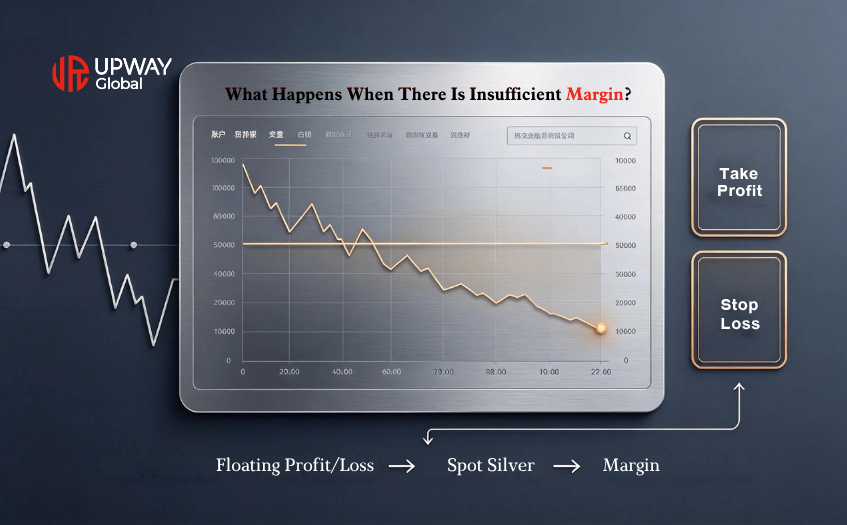
What Happens When There Is Insufficient Margin?
While a position is open, floating profits and losses affect account equity and free margin. When the market moves in a favourable direction, profits increase account equity. Conversely, when the market moves against the position, losses reduce account equity.
If the margin level falls to the platform's specified stop-out level, the system may automatically close open positions.
For example, assume an account has an initial balance of USD 1,000 and a one-lot Spot Silver position is opened with a margin requirement of USD 650. Other trading costs are excluded for simplicity.
· USD 200 in floating profit: Account equity rises to USD 1,200, and free margin increases to USD 550.
· USD 200 in floating loss: Account equity falls to USD 800, and free margin decreases to USD 150.
As shown above, floating profits and losses affect account equity and free margin, while used margin generally remains unchanged as long as the applicable margin requirement stays the same.
If losses continue to increase, the margin level may eventually reach the platform's stop-out threshold. Specific margin call and stop-out conditions are subject to the platform's trading rules.
Common Misconceptions About Margin in Spot Silver Trading
1. Margin is not the same as a trading fee. Margin is used to support an open position, whereas trading fees are costs incurred when trading. Traders should also take other potential costs, such as spreads and overnight financing charges, into account.
2. Margin does not represent the maximum possible loss. Leverage amplifies the impact of price movements on an account. Losses may exceed the initial margin requirement, so margin should never be treated as a cap on potential losses.
3. Margin requirements are not necessarily fixed. Market volatility, exchange requirements and a platform's risk management policies may all affect margin requirements.
Before trading Spot Silver, investors should understand the contract specifications, margin requirements and stop-out rules, and manage their positions according to their financial circumstances.
Upway Global reminds investors that Spot Silver prices can be highly volatile and trading involves market risk. Investors should plan their capital allocation carefully and trade with caution.
This article is for educational purposes only and does not constitute investment advice.





 简体中文

 繁體中文
 English

 TradingView
 MT5 Web
 Spot Gold/Spot Silver
 Accounts
 Wallet
 Promotions
 Trading Tools
 News Updates
 Economic Calendar
 Investment Academy
 Beginner’s Guide
 Anti-Fraud Guide
 FAQs
 Upway APP
 Upway Desktop
 CTOTrader
 Upway HD
 About Upway
 Company News
 Affiliate Program
 Contact Us

